⚠️ Wait — Your Order Is Not Quite Complete · One-Time Offer
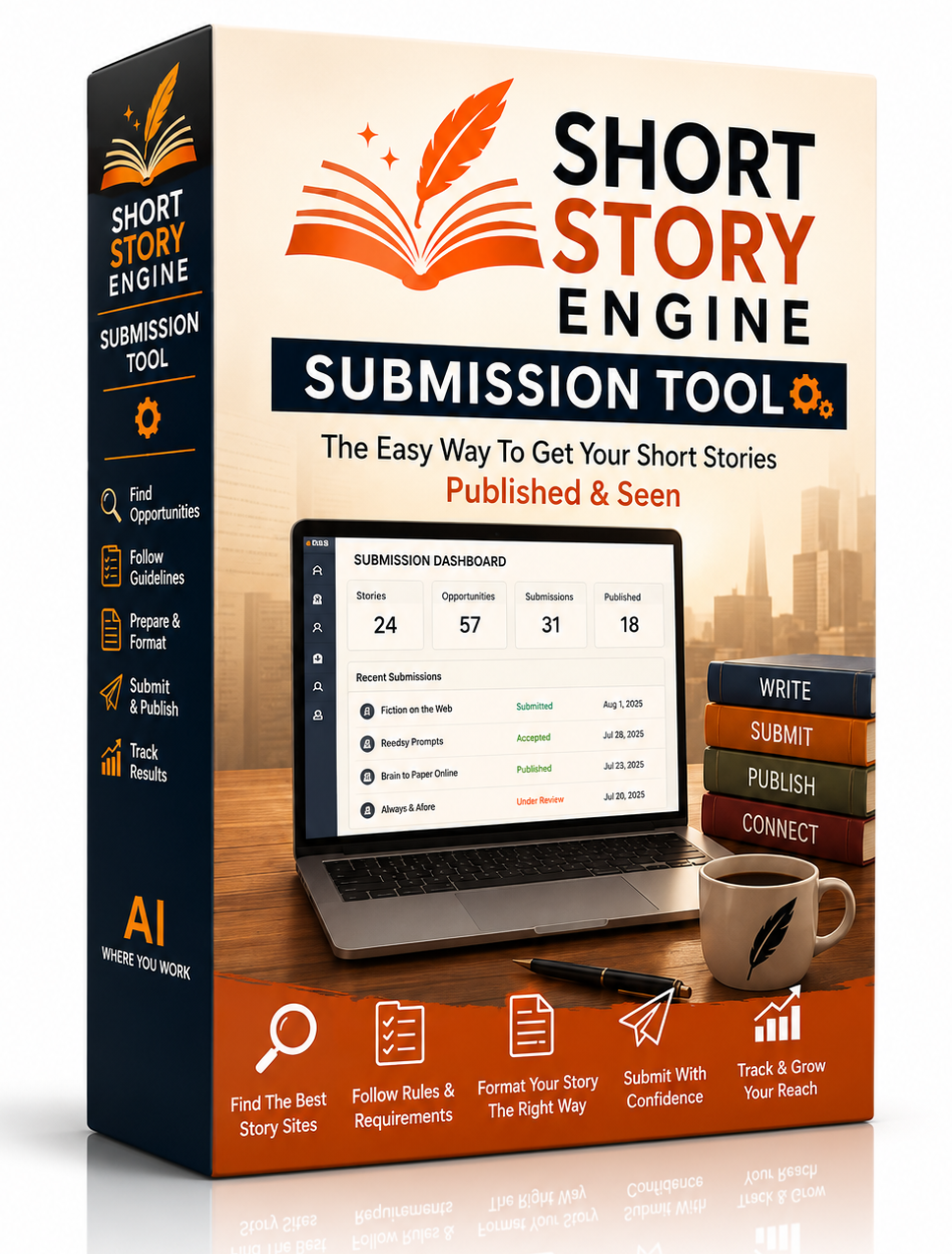
ShortStoryEngine Upgrade · Submission Engine
You've Created The Stories… Now Make Sure They Actually Get In Front Of Readers
ShortStoryEngine Submission Engine turns your finished stories into published reader touchpoints — without guessing where they fit, how they should be prepared, or which rules you might be breaking.
▶ Watch the Submission Engine demo
You've Just Seen How Short Stories Can Help You…
Give readers something valuable before asking for the sale
Build familiarity with your name and your writing
Grow an audience around your characters, books or ideas
Create interest before your full book launches
And give existing books more ways to be discovered
Plus five fast-start bonuses included free today — including the full walkthrough that takes one story from finished draft to published.
But there's one obvious catch. The story has to leave your hard drive.
Creating the story is Step One. Getting it prepared, putting it in the right places, following the rules, and keeping track of what you've published where…
That's the part that turns a story into an audience-building asset.
And that's what the ShortStoryEngine Submission Engine is designed to help you do.
Because A Folder Full Of Great Stories Builds Exactly Zero Audience
You can create the perfect prequel. A great character origin. A brilliant missing scene. A reader-magnet story. A standalone piece that perfectly introduces your world.
But if it sits inside a folder on your computer…
Nobody reads it
Nobody discovers your name
Nobody joins your audience
Nobody becomes familiar with your characters
And nobody has a reason to look for the full book
Creation only becomes promotion when you actually put the work in front of people.
That sounds obvious. But this is where the process gets surprisingly messy.
Where Should You Publish It?
Medium? Substack? Vocal? Wattpad? Royal Road? Inkitt? Tapas? Somewhere else?
Should you publish the whole thing? Serialize it? What word count works? How should it be formatted? Does the platform allow AI-assisted content? Do you need to disclose it? Where? What wording should you use?
Could publishing it there create a problem with Kindle Unlimited? Have you already published this story somewhere else? Which version did you use? When did you publish it?
And what happens when you've got ten stories instead of one?
Every story, the same twenty questions. Or one workflow that already knows them.
Suddenly "Just Publish The Story" Isn't Quite So Simple.
And if the whole reason you bought ShortStoryEngine was to build readers, recognition, authority, audience and momentum — then this is not the part you want to keep putting off.
ii · Introducing
ShortStoryEngine Submission Engine
The publishing & distribution workspace built to help you turn short stories into real reader-facing assets.
Instead of creating the story… then opening another browser tab… then searching for somewhere to put it… then checking the rules… then trying to work out how that platform wants it formatted… then wondering whether you've missed an AI-content requirement… then forgetting where else you already published it…
ShortStoryEngine Submission Engine gives you one guided workflow.
Add the story onceFind a destinationCheck the rulesPrepare the right versionPublish itTrack what you did
One workspace: your stories, your destinations, your publishing history.
The goal isn't to "submit more." It's to build more reader touchpoints.
That distinction matters. This isn't about throwing the same story at every website you can find. And it isn't about spamming platforms.
The objective is much more strategic: put good stories in appropriate places where potential readers can encounter them.
Then use those stories to create familiarity, recognition, reader trust, authority, audience — and more natural paths towards the books you eventually want them to buy.
The more often the right reader encounters something worthwhile from you, the less "unknown" you become.
And if you're building all of this before the main book is finished? Even better. Because now you're not waiting until launch day to begin the relationship.
iii · The Launch You'd Rather Have
Launch Your Book To Your Fans — Not Strangers
Imagine your book is finally ready. Would you rather announce it to…
A. People who have never heard of you
The first thing they ever see from you is a request to buy something.
B. People who have already read your stories
People who recognize your name, your characters, your story world, your ideas and your voice.
Maybe they've already joined your newsletter. Maybe they've already read several things you created. Maybe they've already been waiting to see what comes next.
No software can guarantee a successful launch. But it makes obvious sense that building reader familiarity before launch gives you a better starting position than beginning from zero.
That means every short story you properly publish now can potentially become part of the runway for what you launch later.
The Submission Engine helps you build that runway.
Launch day looks very different when people already know your characters.
iv · The Workflow
Here's How It Works
1
Add Your Story Once
Bring your completed short story into your private story library. Keep the stories you're actively using organized in one place.
No more hunting through Downloads, Google Docs, desktop folders, AI chats and random versions named FINAL-story-v3-REALLY-FINAL.docx
Your stories become part of one publishing workflow.
2
Find Places Where The Story Can Work
The Submission Engine includes a curated publishing-opportunity directory designed around short-story distribution. The initial system focuses on reader platforms including:
Medium, Vocal and Substack
Wattpad and Royal Road
Inkitt and Tapas
Instead of starting every story with another Google search, you start from the publishing opportunities already inside the system — then filter and evaluate them around the story you actually want to publish.
Start from a filtered shortlist instead of a Google search.
3
Check The Important Rules Before You Publish
This is one of the most important parts of the entire system. Because the rules aren't the same everywhere.
Some platforms have particular requirements around AI-assisted content, disclosure, tags, story length, format, rights, previous publication and other publishing conditions.
The Submission Engine helps surface those issues before you publish. Not after somebody flags the story. Not after you've accidentally created a conflict. Not when you can no longer remember what you agreed to. Before.
4
Prepare The Story For The Platform
Different publishing destinations need different outputs. A web publishing platform isn't the same as a serialized-fiction platform.
Web-ready story versions for platforms such as Medium, Vocal and Substack — a clean reader-facing version including story presentation, formatting, teaser/introduction, author bio, soft call to action and relevant disclosure where required.
Serial story packages for Wattpad, Royal Road, Inkitt and Tapas — story sections/chapters, chapter titles, story description, tags, author notes, soft CTAs and relevant AI disclosures.
Instead of staring at a 7,000-word story thinking "okay… where exactly should I split this?" the heavy preparation work is handled inside the workflow.
Same story, two prepared versions — web-ready and serialized.
5
Follow The Publishing Checklist
Once the story is prepared, you're not dumped at the end with a file and a "good luck."
The Submission Engine gives you a guided platform-specific checklist. You can see what needs checking, what needs copying, what needs acknowledging, and where to go next. Then the system gives you the link to the appropriate publishing page.
6
Track Everything In One Place
The first story is easy to remember. The fifth? Maybe. The twentieth? Good luck.
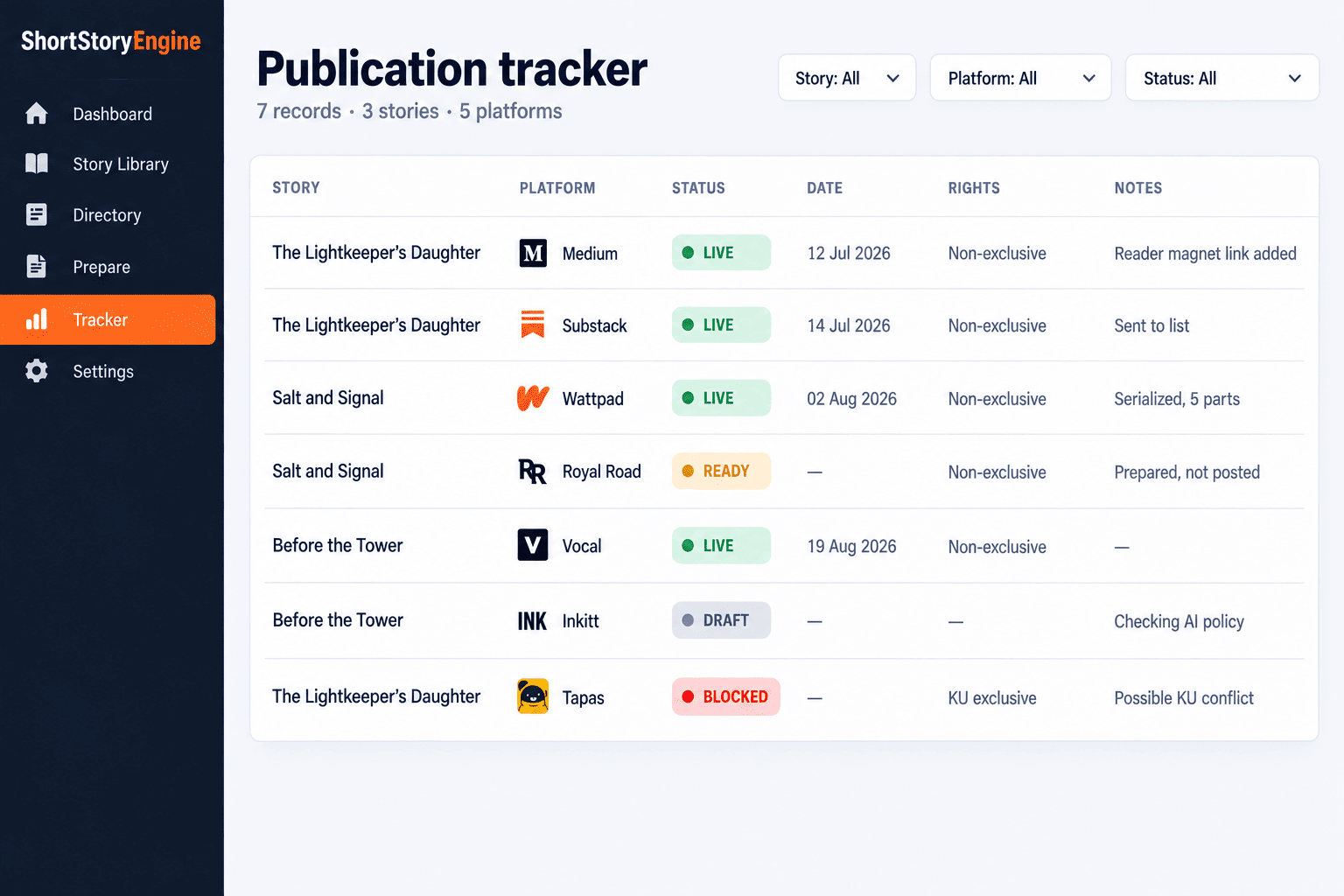
The Submission Engine includes a tracker so you can keep records around:
Which story and which platform
Publication status and dates
Notes and rights information
Payments and responses where relevant
Instead of relying on memory, spreadsheets, browser bookmarks, inbox searches or hoping you remember what you did six months ago — your publishing history stays connected to the story.
Story twenty is still easy to find.
v · The Part Nobody Talks About
AI Disclosure And Kindle Unlimited
AI-assisted story? The Engine helps you handle the disclosure properly.
If you use AI as part of your writing workflow, you shouldn't have to guess whether a platform requires disclosure.
Identifies relevant AI-policy requirements for the destination
Helps prepare the disclosure information the platform expects
Includes required disclosure or tagging in the version it prepares
So instead of wondering "do I have to mention AI here?" you're prompted to deal with it as part of the publishing workflow.
That's not just convenience. That's risk reduction.
The warning you want before you publish, not after somebody flags it.
Publishing on KDP or using Kindle Unlimited? There's another rule you really don't want to discover by accident.
If your work is enrolled in Kindle Unlimited / KDP Select, exclusivity requirements can affect where else that material can appear. And when you're creating prequels, companion stories, bridge stories, serialized versions and reader magnets, it becomes very easy to lose track of what is live where.
Something already published elsewhere and you're thinking about KDP? You get a warning.
Something tied to KDP exclusivity and you're about to put it somewhere else? You get a warning.
You still make the publishing decision. But you make it with your eyes open.
You Stay In Control Of The Final Publish
That's deliberate. ShortStoryEngine Submission Engine does not secretly log into third-party accounts and spray content around the internet.
It prepares. Checks. Guides. Organizes. Then you make the final publishing decision.
That keeps your accounts and your publishing relationships under your control.
vi · The Bigger Picture
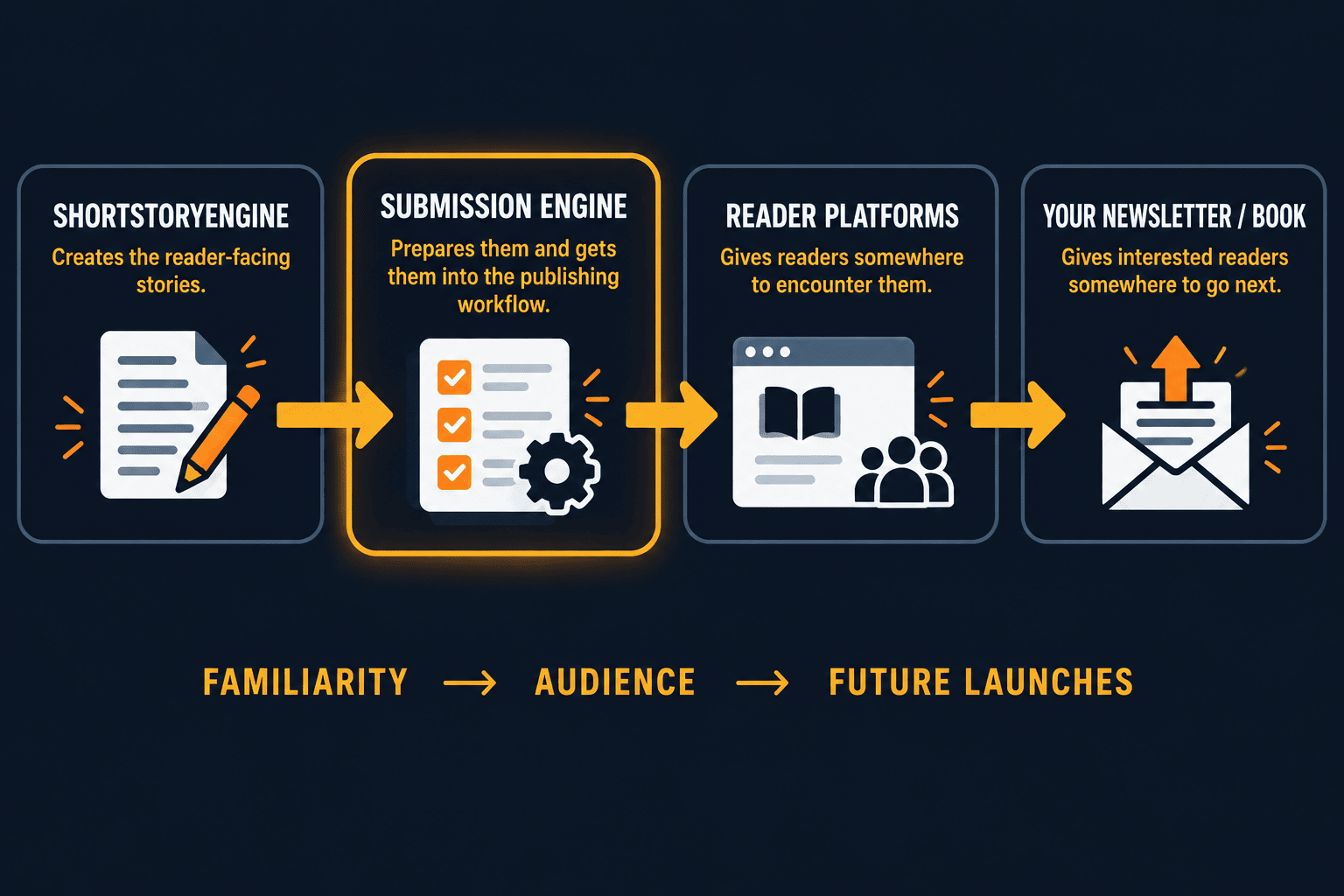
Think Of It As Your Audience-Building Production Line
▼
ShortStoryEngine
Creates the reader-facing stories.
▼
Submission Engine
Gets those stories properly prepared and into the publishing workflow.
▼
Reader Platforms
Give potential readers places to encounter them.
▼
Your CTA / Reader Magnet / Newsletter / Book
Gives interested readers somewhere to go next.
Four stages, one direction of travel.
Familiarity → Audience → Future launches
At first it's one story and a few platforms. Easy.
But if ShortStoryEngine does what you bought it to help you do, you'll create more. Another story. Another character. Another prequel. Another reader magnet. Another bridge story.
Now you're building a library of reader-entry points. And that requires a system.
Because the goal isn't to run one short-story promotion. It's to make short stories part of how you build your publishing audience.
vii · Whichever Applies To You
Deploy What You've Already Created
Already Have A Published Book? This Is How You Start Creating More Roads Back To It.
Take the world you already built. Create the companion stories. Then actually put them to work.
A prequel does nothing sitting on your drive. A side-character story does nothing inside an AI chat. A reader magnet doesn't build a list until readers can discover it.
ShortStoryEngine helped you create the asset. The Submission Engine helps you deploy it.
Book Still Coming? This May Be Even More Valuable.
Because you have time. You can create the stories now. Start publishing them. Start building reader familiarity. Start developing your voice and world. Start giving people things worth reading. Potentially start building your audience. Then keep creating the full book.
By the time launch arrives, you may already have a body of reader-facing work out there doing its job.
Again: no guarantees. But that's a much stronger strategic position than waiting until the book is uploaded to Amazon before asking "now where do I find everybody?"
Writing Nonfiction? This Is How Authority Gets Built Too.
Authority rarely comes from announcing "I'm an authority." It comes from repeatedly putting useful, interesting work in front of people.
For fiction authors the same principle works slightly differently — you're building recognition, reader confidence, familiarity and affinity. People begin to know what kind of experience they get from you.
Either way: repeated value before the ask changes the relationship.
viii · Included Free Today
Five Fast-Start Bonuses Included With This Upgrade
Four of these remove the things that slow an author down between finishing a story and publishing it properly. One of them makes sure you don't spend the next twelve months working from rules that have already changed.
Bonus One
Publish Your First Story Tonight
$67 Value
A complete screen-share walkthrough. One story taken from finished draft to published, start to finish, without cuts.
Not a feature tour. The actual working sequence — add the story, pick the destination, check the rules, prepare the version the platform wants, work the checklist, publish, log it.
Watch it once and you'll know exactly what the first hour looks like. Then do the same thing with your own story while it's still fresh.
✓ In your members area
Every step of the first hour, recorded in the real app.
Bonus Two
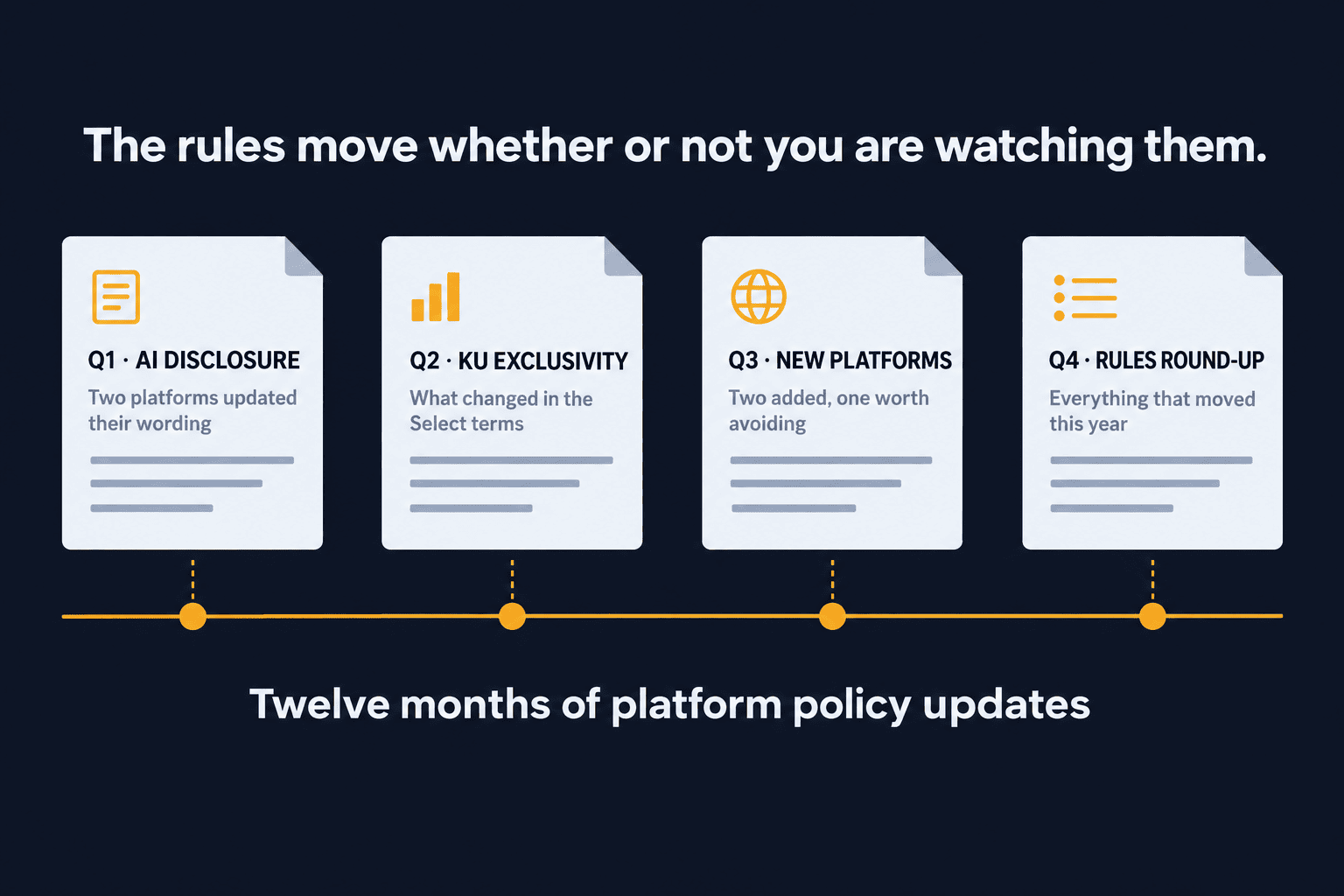
Twelve Months Of Platform Policy Updates
$97 Value
Platform rules move. AI disclosure requirements get written, rewritten and tightened. Exclusivity terms get reworded. What was allowed last spring gets flagged this autumn.
This is the part most tools quietly leave you to discover on your own. Your licence includes twelve months of policy updates covering:
AI-content and disclosure rule changes on the platforms in the directory
KDP Select and Kindle Unlimited exclusivity term changes
Submission, formatting and rights requirement changes
Platforms worth adding — and platforms worth avoiding
A large share of publishing platforms still have no published AI policy at all. That will not stay true for twelve months. When it changes, you hear it from us instead of from a takedown notice.
✓ Delivered across your licence year
The rules move whether or not you are watching them.
Bonus Three
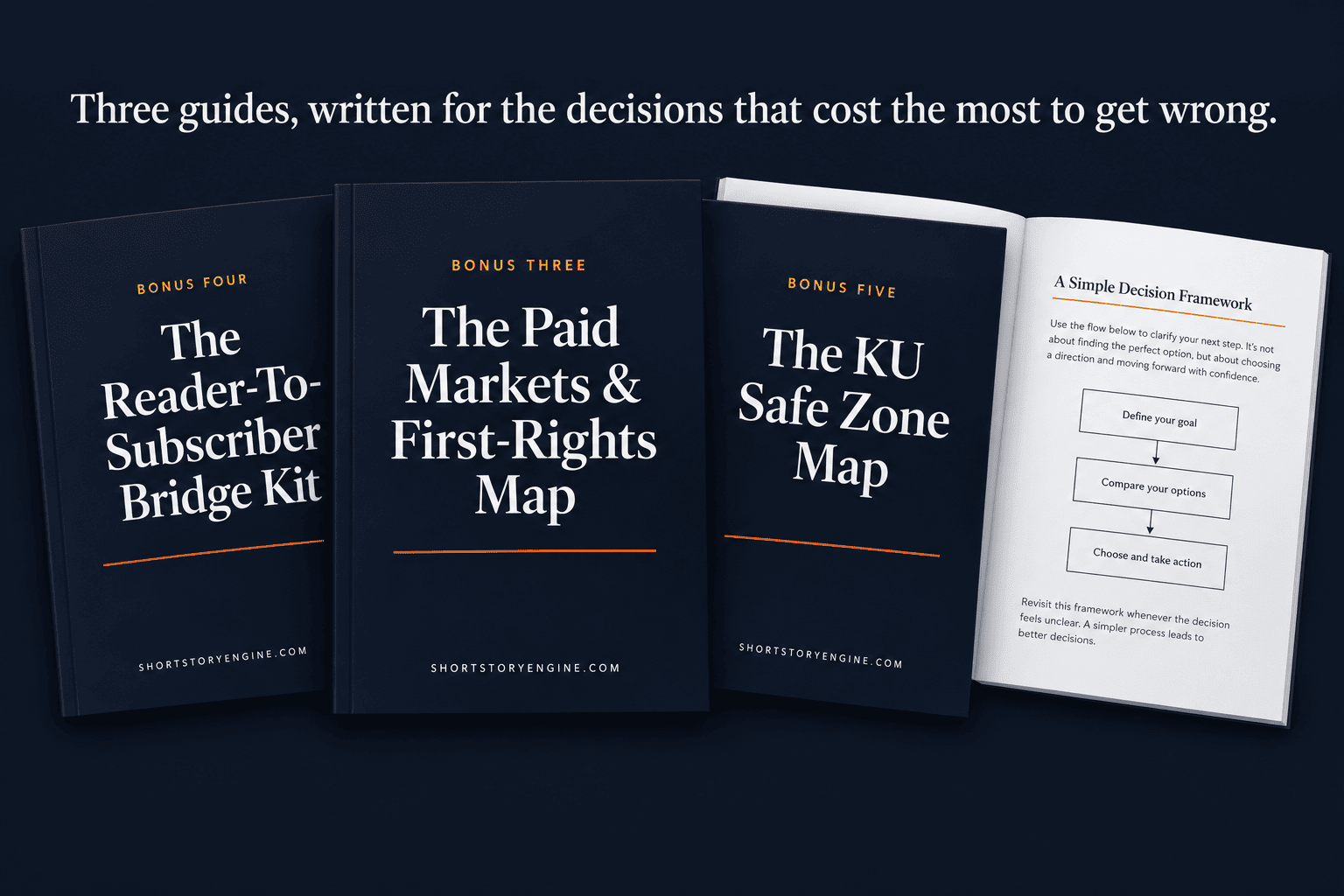
The Paid Markets & First-Rights Map
$67 Value
Publishing your story on a reader platform is not a neutral act. It permanently ends that story's eligibility at nearly every paying market — and deleting the post afterwards does not undo it.
Most authors learn that rule the expensive way, on a story they could have sold.
This map gives you the order of operations before you need it:
Which markets actually pay, what they pay, and which genres they want
Which ones ban AI-assisted work outright — including the best-paying names — and the small number that accept it with disclosure
What "previously published" really means, and why audience size makes no difference
Reprint markets that pay for work already online, which is the route left open once a story has been published
The sequence that keeps both doors open instead of closing one by accident
It pairs directly with the tracker, because the tracker is what tells you where each story has already appeared.
✓ In your members area
Bonus Four
The Reader-To-Subscriber Bridge Kit
$97 Value
Publishing builds you an audience on somebody else's platform. This is how some of that audience becomes yours.
Author bio blocks written to work at the foot of a story, not on a CV
Soft call-to-action swipes written per platform, because what reads naturally on Medium reads wrong on Royal Road
The story-end handoff — the few lines between "the end" and the ask that decide whether anyone clicks
A reader-magnet landing page template for the other end of that click
The stories create the familiarity. This is the part that turns familiarity into a name and an email address you still own if a platform changes its mind.
✓ In your members area
Bonus Five
The KU Safe Zone Map
$47 Value
One page. A decision flowchart you can keep open beside you, plus a plain-English explainer on the question that catches people out: what actually counts as the same work?
Is a prequel the same work? A deleted scene? A rewritten version?
Does changing the title change anything?
What an excerpt is allowed to be, and where the line sits
What enrolment does to material you have already published elsewhere
The Engine warns you when it spots a conflict. This is the page that tells you what to do about it.
✓ In your members area
Three guides, written for the decisions that cost the most to get wrong.
Bonus Value Included Today
$375
ix · What You Get
Inside ShortStoryEngine Submission Engine
Private Story Library
Keep your working short-story assets organized in one place.
$27 Value
Publishing Opportunity Directory
Find appropriate reader platforms and publishing opportunities without starting the research process from scratch every time.
$97 Value
Story / Platform Fit Guidance
Help identify whether your story fits the basic requirements of the destination you're considering.
$47 Value
Web Story Formatter
Prepare story versions for web-first publishing platforms.
$67 Value
Serial Story Formatter
Turn suitable stories into organized serial packages for fiction platforms.
$67 Value
AI Policy Checks
Surface platform AI-content requirements and help you deal with relevant disclosure rules.
$47 Value
Automatic Disclosure Support
Where the publishing workflow requires disclosure or tags, prepare the necessary information as part of the story version.
$37 Value
Kindle Unlimited Conflict Warnings
Help flag situations where publishing a story in another location could create a potential KDP/KU exclusivity issue.
$97 Value
Platform Publishing Checklists
Know what needs to happen before you publish.
$27 Value
Guided Publish Links
Move directly from preparation to the correct third-party publishing destination.
$17 Value
Publication / Submission Tracker
Keep the story, platform, status, dates and notes together.
$67 Value
Bonuses Included Free Today
Publish Your First Story Tonight
Full screen-share walkthrough: one story from finished draft to published.
$67 Bonus
Twelve Months Of Platform Policy Updates
AI disclosure, KU exclusivity and platform rule changes, across your licence year.
$97 Bonus
The Paid Markets & First-Rights Map
What paying markets want, which ban AI work, and the publishing order that keeps both doors open.
$67 Bonus
The Reader-To-Subscriber Bridge Kit
Bios, per-platform CTA swipes, the story-end handoff and a reader-magnet landing page.
$97 Bonus
The KU Safe Zone Map
One-page decision flowchart plus a plain-English guide to what counts as the same work.
$47 Bonus
Total Value If Bought Separately
$972
Values shown reflect what it costs to buy or do this work separately.
Add It To Your Order Today
Total Value: $972
First-Year Licence: $47
Your first-year licence can be purchased without being forced into an automatic annual renewal.
One story is content. A system of published stories can become an audience asset.
You don't need every story to go viral
You don't need every reader to buy
You don't need to be everywhere
You need a repeatable way to create, prepare, publish, track — then do it again
You Don't Need More Unpublished Content. You Need More Published Reader Experiences.
There will always be another idea. Draft. Prompt. Outline. Tool. Course. Character. Book.
But an audience isn't built by the size of your content folder. It's built by people experiencing the work.
ShortStoryEngine Submission Engine closes that gap.
From "I made this" → to "people can actually read this."
xi · Questions
Frequently Asked Questions
Does the Submission Engine automatically submit stories for me?
No — and that's deliberate.
The system helps you prepare the story, deal with relevant requirements, follow the publishing workflow and reach the correct publishing page. You remain in control of the final submission or publish action.
That avoids handing third-party account access to automated software and keeps the publishing decision with you.
Do I need ShortStoryEngine to use this?
The Submission Engine is designed as the execution layer for the stories and strategy you've just purchased through ShortStoryEngine. It takes the completed story and helps move it into the publishing/distribution stage.
Can I use stories I already wrote?
Yes. You're not limited to stories created with ShortStoryEngine. Add your own existing short stories and use the publishing workflow around them.
What if I haven't finished my main book?
That's one of the strongest reasons to start. You can create and publish short stories around your developing characters, world or subject while the full book is still being completed.
That gives you the opportunity to begin building reader familiarity earlier.
Does it guarantee traffic or readers?
No. Publishing a story does not guarantee that people will discover it, read it or buy another book.
The Submission Engine is designed to make it easier to create more legitimate reader-discovery opportunities and execute the short-story audience-building strategy consistently.
Does it guarantee my story meets every platform rule?
No third-party platform stays permanently unchanged. The system is designed to surface and help manage important publishing requirements, but you should always review the current rules shown by the destination before final publication.
You remain responsible for your publishing decisions.
Why does the AI disclosure feature matter?
Different platforms can have different rules around AI-assisted content. Rather than relying on memory or hoping you haven't missed something, the Submission Engine builds those checks into the publishing workflow and can help include appropriate disclosure information where required.
What about Kindle Unlimited?
If the same content is being used elsewhere while subject to KDP Select / Kindle Unlimited exclusivity requirements, that can create issues.
The Submission Engine includes warnings designed to help surface potential conflicts before you proceed. Always check the current Amazon terms when making a final publishing decision.
How do I get the five bonuses?
They're in your members area. There's no separate claim page and no bonus email to chase — the walkthrough, the Paid Markets & First-Rights Map, the Bridge Kit and the KU Safe Zone Map are waiting for you when you log in.
The platform policy updates are the exception, for the obvious reason: those reach you as the rules change, across your licence year.
Can I track where my stories have been published?
Yes. The tracker is one of the core parts of the application. Keep records around the story, destination, status, dates and relevant notes in one place.
xii · One Step Left
You've Already Done The Creative Part. Don't Stop One Step Before The Story Can Start Doing Its Job.
Create the story. Prepare it properly. Put it in front of readers. Track what you did. Repeat.
And start turning a collection of short stories into something much more valuable: a growing body of work people can discover before you ever ask them to buy the main book.
Build the audience first. Build the authority first. Build the familiarity first.
P.S. — This is the only place the Submission Engine is offered at this price as part of your ShortStoryEngine order. Once you leave this page, it goes back to standard pricing.
P.P.S. — The stories you're about to create are only worth what readers can actually reach. Everything else is a folder.